During the ILN’s 2010 Regional Meeting of the Americas in Houston, Texas last week, we were treated to a presentation by our host firm’s managing partner, Martin Beirne of Beirne Maynard & Parsons, and Jeff Carr, Senior Vice President, General Counsel, and Secretary of FMC Technologies.  Jeff’s presentation focused on "Getting Out of the Box in Counsel Engagement and Service Delivery – the Value Challenge." 

Beirne introduced Carr, saying that he’s the author of the Associate of Corporate Counsel’s Value Challenge – something that he’s been talking about for fifteen years.  Carr said that FMC Technologies is a 9 year old company, with about 120 years of history, and is one of those that touches people’s lives in many ways.  

Carr jumped right into talking about his experience as a general counsel, saying that his legal spend is less today than it was in 2001, in a world where firms’ rates go up 10% a year.  He added that FMC Technologies pays, on average, 107% of their invoices to law firms – he would later explain how and why this happens.

How is it possible to have a smaller legal spend? Carr said companies need to change how they buy what they buy, how they pay for it, and go from being reactive lawyers to being proactive lawyers.  What drives him? If he can save his company $1 million, that equates to a half a cent of share earnings.  That’s what drives companies.

He said that his legal team’s mission statement says that they’re not lawyers – they’re there to help achieve business goals.  Only one person who is currently on his team was with him in 2001 because the others either didn’t want to move when they changed their headquarters to Houston, or they didn’t want to practice law the way that his team does.  They were not willing to embrace change and the discipline that they require to be successful lawyers at FMC Technologies.Continue Reading ILN Conference Re-Cap: Getting Out of the Box in Counsel Engagement and Service Delivery – the Value Challenge

After lunch, ALM’s Social Media: Risks & Rewards conference focused more on the rewards of social media.  The Brand Protection and Promotion of Social Media session featured Jennifer Arkowitz from Townsend and Townsend and Crew as the moderator, and David Morris, Senior Corporate Counsel of TripAdvisor, Alexandra Sepulveda, Trademark Counsel with General Mills, and Johanna Sistek, Trademark Counsel for Google, Inc. as speakers.  

Proactive or Reactive? 

Arkowitz’s first question was whether each of the companies were more proactive or reactive in their social media efforts.

Sepulveda (General Mills) said that for them, it’s a combination. When Facebook had a big land grab for user names, they went through their brand list and got all of those names.  She said that as trademark lawyers, they’re classic hostages, because if they know about something, they have to do something about it.  

Sistek (Google) said that they have issues raised internally from employees as well as users, so they’re able to be reactive instead of proactive. She added that all of their teams use social media in what they do.

Morris (TripAdvisor) commented that they’re both proactive and reactive. Being an online brand is core to what they do, so although they don’t have a dedicated social media team, about half the company is working on social media. They do that internally and externally. TripAdvisor uses small firms to scour the net for mentions of their company – this is at a cost, but it does help to find those mentions.Continue Reading Conference Re-cap: ALM’s Social Media; Risks and Rewards Brand Protection and Promotion and Social Media

Yesterday, part I discussed the Chinese and Hong Kong perspectives on the global financial crisis and its effect on their business. Part II will talk about the Vietnamese perspective and the justice systems in China and Vietnam.

Peter asked Phan Nguyen Toan from LEADCO what he was seeing in Vietnam, saying that a number of US companies are looking to Vietnam as an alternative for production and manufacturing. Phan agreed that Vietnam is similar to China, in that they didn’t suffer much from the economic downturn. He cited their recent entry into the international community as one reason for this. He said they are struggling in some ways, saying that a company recently opened a big factory, where they were planning to recruit 10,000 workers. After two years, they had only been able to hire twenty percent of the qualified workers. He added that they were also facing additional issues of poor infrastructure, particularly the seaport, airport, and transportation systems. 

However, Phan noted that they have some distinct advantages in Vietnam as well, such as the lower costs for good resources. Secondly, he said that the Vietnamese people tend to be very hardworking and eager to learn. The country is rich in natural resources. Phan added that the population of Vietnam is very young, with about 50% being under 35.Continue Reading How Has the 2009 World Economic Downturn Affected the Asia Pacific Region? A Re-cap from 2010 Annual Meeting (Part II)

In addition to our regular Annual Meeting, we also had a special session for our Asia Pacific delegates to discuss the strengths of the firms in the region, recent cases they had been handling, and the interesting and important question of "How has the 2009 world economic downturn affected the Asia Pacific Region?" This question prompted a discussion of the current marketplace that may be of greater value than just to the attendees.

Scott Guan from Jade & Fountain in Shanghai kicked off the discussion with an update from China, saying that they hadn’t been hit as hard by the global financial crisis as some of the other markets. The effects that they’d seen were mostly in the areas of cross-border work, as well as foreign-related financing, M&A, and capital markets work. He’d seen a greater impact of the crisis on multinational law firms in China, who have had to lay off a lot of lawyers.  

But this has turned out to be an opportunity for a local law firm with international expertise, such as Jade & Fountain.  The firm was recently ranked as one of the top 10 fastest growing Chinese firms by the Asian Legal Business journal. Scott said that because there are so many qualified lawyers on the market from these multinational firms, who his firm wouldn’t have had access to in a more prosperous economic situation, they have been able to actively recruit these attorneys. Because of the firm’s well-designed partner incubation system, the firm has brought in attorneys from Allen & Overy, Freshfields, Allens Arthur Robinson, Baker & McKenzie and Jones Day.Continue Reading How Has the 2009 World Economic Downturn Affected the Asia Pacific Region? A Re-cap from 2010 Annual Meeting (Part I)

On Saturday, we had another session that was of interest to the delegates – a presentation on Effective Benefit Programs. The presenter was Stanley Jeremiah, the Vice President and Managing Director for Asia Pacific HR Management at Convergys.  Stanley is also a chartered insurer with UK professional qualification, a fellow of the Chartered Insurance Institute, and a council member of the Singapore Insurance Institute.  His talk focused on one small area of firm management, benefits, and he gave a general overview since benefits are country-specific.  

One of the characteristics of a benefits program is that it’s a more subtle form of compensation than remuneration, because it’s not often communicated to employees in terms of cost.  As a result, it’s less comparable to benefits packages at other firms and isn’t well-leveraged as a differentiating factor when recruiting talent.  Because benefits aren’t given this importance, employees often don’t know what benefits they have and as a result, are not as appreciative as they could be, because they don’t understand the value.  Stanley said that if firms can use benefits packages effectively, they could become something that has a higher perceived value than the actual cost.  Continue Reading Effective Benefits Programs – an ILN Conference Re-cap

Although generally I would make every effort to offer posts from our ILN conferences as they happen, in this case I am forced to write them after the fact.  Because of the political turmoil in Bangkok, we had to make the decision four weeks before our Annual Meeting to move the conference to Singapore, so I was knee deep in last minute decisions and more on-site planning and execution as a result than is normally the case.  So without further ado, I bring you some of the highlights from the ILN’s 22nd Annual Meeting in Singapore! 

In the first days of our visit, we had the pleasure of visiting Maxwell Chambers, the home of the Singapore International Arbitration Centre, where we met their head of business development, Ms. Rachel Foxton, and their CEO, Mr. Ming Naing Oo.  We saw several of their hearing rooms and learned more about the benefits of arbitration in Singapore during our Saturday morning session.  Continue Reading SIAC – Arbitration in Singapore, an ILN Conference Re-Cap

On Wednesday, May 12th, I was fortunate enough to attend a couple of sessions at American Lawyer Media’s Law Firm Marketing and Business Development Leadership Forum. The ILN was a marketing partner for the event, and I spoke on a panel called "Going, Going…Global? The Worldwide Marketing for Legal Services." Unfortunately, I have not yet mastered the art of tweeting from a panel I’m participating in (and so don’t have comprehensive notes for a re-cap), but the first session of the morning on the changing nature of in-house and outside counsel relationships was full of great takeaways for law firms and their marketing departments.  If you’re interested in the full list of tweets from the conference, you can check out the #LCMO hashtag transcript.
On the panel were:

Continue Reading Re-cap of ALM’s Law Firm CMO Forum: Inside/Outside Counsel Relationship

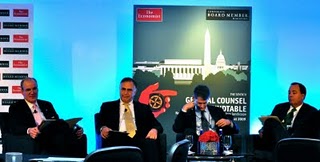
DSC_0023.jpeg The fourth session of the day at The Economist’s 7th General Counsel Conference focused on “The GC, the board and governance issues,” with a panel that included moderator TK Kerstetter, President and Chief Executive Officer of Board Member Inc/Corporate Board Member, Marty Wilczynski, Senior Managing Director at FTI Consulting, Stephen Cutler, Executive Vice-president and General Counsel of JPMorgan Chase, Bruce Vanya, Partner at Katten Muchin Rosenman LLP, and Ed Knight, Executive Vice-president, General Counsel, and Chief Regulatory Officer at NASDAQ OMX.

Kerstetter introduced the panel by saying that there are multiple topics that they could talk about surrounding the issue of governance, but he would start with the SEC.  He said that people thought Mary Shapiro would be just a placeholder, but she’s been upfront, particularly with enforcement.  Cutler, having worked at the SEC in the past, had a unique perspective and wanted to give the audience a sense of where enforcement is going.  First, he said there is a more prosecutorial bent than ever before, because of the personnel makeup.  He said this would change the shape of the SEC and make them more attuned to cooperation, such as rewarding the first person in the door.  He also said it meant they would be rapping people hard and would be less attuned to what securities enforcement defense lawyers have paid attention to for a living.  As a result, there would be more negotiating room around the edges.  Secondly, there will be an emphasis on speed.  Over the last few years, they have let cases drift, tempered by what Judge Rakoff did with the Bank of America case.  Third, there will be more power of and to the staff, which means less checks & balances.  Fourth, there has been a move on the part of the enforcement division to specialize and fifth, there is more of a focus on individuals.  Before, they used to hold companies responsible, but not individuals, which is changing.  Cutler pointed out that the SEC will now see everything they do through the prism of Madoff and Bear Stearns, as well as from an agency that wasn’t sure it would even exist anymore nine months ago.  Wilczynski said that with respect to the current environment, it’s fair to say that they’ll be active in the next few years, but he’s seeing mixed signals.  With the reorganization taking place, slots aren’t being filled aggressively.  So though they’re active, the reorganization is slower than expected and there is an impact offset by the public record.  In the last five years or so, the number of formal orders that the commission issued was about half of the 450 orders that have already been issued in 2009.  It doesn’t feel that busy, but in public, they seem to be fully geared up, while in reality, there are still reorganization issues slowing things down.  2010 will be much busier.

Continue Reading The Economist’s General Counsel Roundtable Session Review: The GC, the board and governance issues

DSC_0020.jpeg After a short networking break, we reconvened at The Economist’s 7th General Counsel Conference for a panel discussion of “The election of directors: Could 2010 be the perfect storm?” The panel included moderator TK Kerstetter, President and Chief Executive Officer of Board Member Inc/Corporate Board Member, Michael McAlevey, Vice-president and Chief Corporate, Securities and Finance Counsel of General Electric, Peggy Foran, Vice-president, Chief Governance Officer, and Corporate Secretary of Prudential Financial, and Shelley Dropkin, General Counsel, Corporate Governance of Citigroup.

Kerstetter asked the panelists to start by commenting on their biggest concerns as the proxy season gets started.  Dropkin said that it’s a combination of losing 452 on directors and majority voting, which could have unintended consequences.  Now there’s a great concentration of institutions, activists and investors in the vote and she’s concerned about the degree to which they’re influenced by proxy advisors.  Dropkin asked how responsible would institutions be in exercising their vote.  She foresees a lot of strange results that could occur and have magnified impact because of the reduction of the retail vote.  McAlevey said that he is concerned about a couple of things.  Tactically, for a company like his, they have a significant retail vote, so this is meaningful and they need to come up with a way to encourage them to vote. They’ll need to look at the discretionary vote and do the math, so that they can see how it will affect them.  He suggested hiring a proxy advisor firm to find new ways to contact and remind people to vote.  His more seismic point was that much attention is focused on giving more weight to shareholders without making adjustments, but the economic crisis in 2008 was also the shareholders responsibility.  The steps being taken may empower shareholders even more and encourage short-term interests.  Foran believes there will be directors who are not elected.  She said that activists kill what is already dead.  Agreeing with the others, she shared that she was afraid of the impact on the boardroom.  They’ll need courageous directors for the future, because those doing the right thing may get voted off.  She feels it will be important for directors to communicate and engage, to tell their story before someone else tells it.Continue Reading The Economist’s General Counsel Roundtable Session Review: The election of directors: Could 2010 be the perfect storm?

DSC_0019.jpeg The second session of The Economist’s General Counsel Roundtable was a panel on the topic of “Balancing the growth imperative with escalating risk.”  Matthew Bishop, the US Business Editor for The Economist moderated the panel, which included John Lynch, US General Counsel of BP America and Deirdre Stanley, the Executive Vice-president and General Counsel of Thomson Reuters.

Lynch started with his view of the role of the general counsel in risk management, based on his own experience. He feels there’s an element of getting ahead of governance and reporting to the Board, but the role of the GC is different for each company, based on its needs.  The answer to the role of the GC lies with the unique factors of the company, subject to risk, which is a broad topic.  He then defined what he sees as the four different types of risk: compliance risk, legal risk, function risk, and event risk.  Stanley said that at Thomson Reuters, it is lightly regulated, so their strategies and processes aren’t tied up in a lot of regulation.  She sees the role of the GC as risk identification and risk environment identification, which she defined as the point at which they trip up on a new regulation that wasn’t applicable before.  As the Foreign Corrupt Practices Act seeks to become increasingly global, the articulation of risk itself is important, because changing operations increases the risk that they might not have otherwise identified.  Mitigation is the third part of a GC’s responsibilities and requires the close integration of legal with operations.

Bishop then asked, with the push to be more global, how do they help managers to understand how to do business in China, for example.  Lynch answered that they tell them that risk management is what they see in the case law around governance, not what Seth Harris described about deciding whether to comply.  Bishop followed up by asked about the trade-off between growth and risk management.  Lynch agreed that he feels that there is a trade-off, but they’re trying to prevent it at BP.  He said that to grow, they can either access a new country or become more efficient, which is tougher.  To grow, they need to identify the risks, a mitigation plan, and how to fund it.  Stanley said that she doesn’t see it as a trade-off, but as a balance.  As in any business, without risk, there’s no reward.  The challenge is how to grow in a greater risk environment, so she works to instill risk management awareness in managers and encourages leaders to be involved in all incremental changes.  Lynch added that it’s important to have legal and compliance in the same complement as the business is expanding, and not after or towards the end of planning. Continue Reading The Economist’s General Counsel Roundtable Session Review: Balancing the growth imperative with escalating risk