


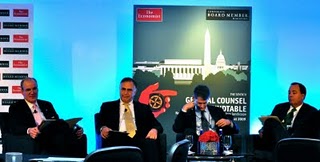
 The fourth session of the day at The Economist’s 7th General Counsel Conference focused on “The GC, the board and governance issues,” with a panel that included moderator TK Kerstetter, President and Chief Executive Officer of Board Member Inc/Corporate Board Member, Marty Wilczynski, Senior Managing Director at FTI Consulting, Stephen Cutler, Executive Vice-president and General Counsel of JPMorgan Chase, Bruce Vanya, Partner at Katten Muchin Rosenman LLP, and Ed Knight, Executive Vice-president, General Counsel, and Chief Regulatory Officer at NASDAQ OMX.
Kerstetter introduced the panel by saying that there are multiple topics that they could talk about surrounding the issue of governance, but he would start with the SEC. He said that people thought Mary Shapiro would be just a placeholder, but she’s been upfront, particularly with enforcement. Cutler, having worked at the SEC in the past, had a unique perspective and wanted to give the audience a sense of where enforcement is going. First, he said there is a more prosecutorial bent than ever before, because of the personnel makeup. He said this would change the shape of the SEC and make them more attuned to cooperation, such as rewarding the first person in the door. He also said it meant they would be rapping people hard and would be less attuned to what securities enforcement defense lawyers have paid attention to for a living. As a result, there would be more negotiating room around the edges. Secondly, there will be an emphasis on speed. Over the last few years, they have let cases drift, tempered by what Judge Rakoff did with the Bank of America case. Third, there will be more power of and to the staff, which means less checks & balances. Fourth, there has been a move on the part of the enforcement division to specialize and fifth, there is more of a focus on individuals. Before, they used to hold companies responsible, but not individuals, which is changing. Cutler pointed out that the SEC will now see everything they do through the prism of Madoff and Bear Stearns, as well as from an agency that wasn’t sure it would even exist anymore nine months ago. Wilczynski said that with respect to the current environment, it’s fair to say that they’ll be active in the next few years, but he’s seeing mixed signals. With the reorganization taking place, slots aren’t being filled aggressively. So though they’re active, the reorganization is slower than expected and there is an impact offset by the public record. In the last five years or so, the number of formal orders that the commission issued was about half of the 450 orders that have already been issued in 2009. It doesn’t feel that busy, but in public, they seem to be fully geared up, while in reality, there are still reorganization issues slowing things down. 2010 will be much busier.




 Welcome to ILN-terviews, a series of profiles of ILN member firm attorneys, designed to give a unique insight into the lawyers who make up our Network.
